Choosing a zipper can seem like a small decision. Then a coil snags on a jacket cuff, or molded teeth feel stiff across a bag opening. That is where the difference between resin and nylon zippers becomes practical. If you are asking, “what is the difference between resin and nylon zippers,” the key distinction is their construction: resin zippers generally use separate molded plastic teeth, while nylon zippers use a continuous coil of nylon stitched to the zipper tape.
That structure affects appearance, flexibility, and how each zipper sits on a product. Resin teeth look defined and can suit heavier jackets, bags, and outdoor gear. Nylon coil zippers bend smoothly around curves and often feel lighter on clothing or luggage. Still, material alone does not guarantee strength or quality. Tooth size, tape, slider, stitching, and manufacturing all matter. A well-made zipper can outperform a poorly matched alternative.
A named industry expert and a verified quotation were not supplied, so I will not invent an attribution. A useful guiding thought is: “Choose the zipper for the product’s movement and load, not just its material name.” That is a practical rule, not a universal test. Compare the zipper against the item it must serve: flex the tape, run the slider, and inspect how the teeth or coil engage. Small details matter.
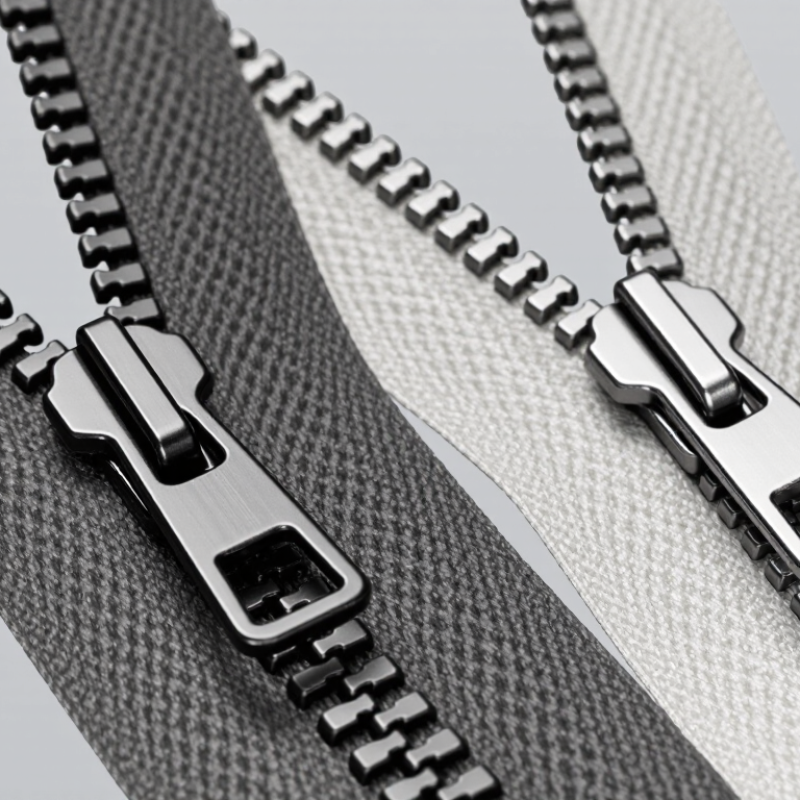
Resin and nylon zippers differ mainly in how their teeth are formed and attached. Resin teeth are molded as separate shapes, often from polyacetal, then fixed along the zipper tape. Their squared profiles can feel firm beneath your fingers. Nylon zippers use a continuous nylon filament, formed into a coil and stitched to the tape. The coil bends easily around curved openings, while molded teeth usually hold a more defined shape. “Nylon” describes the material; “coil” describes the construction.
These differences affect assembly and testing. Molded teeth must align evenly, or the slider may catch at a tooth. Coil zippers rely on consistent stitching and coil spacing. ASTM D2061-07(2021), an industry test method, evaluates zipper strength at several points, including the chain, stops, and slider lock. It does not give one universal strength value for every zipper. Results depend on size, tape, stitching, and construction. That detail is easy to overlook.
Tips: Inspect the zipper on a sample garment. Run the slider slowly over seams and corners; a small snag can reveal uneven alignment.
| Feature | Resin Zipper | Nylon Zipper |
|---|---|---|
| Common tooth design | Usually has separate, molded plastic teeth attached at intervals along the zipper tape. | Usually has a continuous nylon monofilament coil that forms the interlocking elements. |
| How the elements are made | Teeth are commonly formed by molding plastic, often polyacetal, into individual shapes. | The coil is commonly made from nylon monofilament and shaped into a spiral before attachment to the tape. |
| How elements are attached | Molded teeth are typically secured along the edge of the tape, often by injection molding directly onto it. | The coil is typically sewn or woven onto the edge of the tape. |
| Appearance | Often has distinct, visible teeth with a more pronounced shape. | Often has a fine, spiral-like appearance; the coil may be less visually prominent. |
| Flexibility | Generally less flexible than a coil zipper of a similar size, though flexibility varies with tooth size and tape construction. | Generally flexible and able to follow curves, making it useful for curved openings. |
| Typical feel and profile | Often has a firmer, more structured feel because of its separate molded teeth. | Often has a relatively soft, lightweight feel because its elements form a continuous coil. |
| Common uses | Frequently used in jackets, bags, luggage, and other products where a defined tooth appearance is desired. | Frequently used in apparel, bags, sportswear, and applications that benefit from a flexible zipper chain. |
| Key construction difference | The chain is made from individual molded plastic teeth attached along the tape. | The chain is made from a continuous nylon coil attached along the tape. |
| Important variation | Materials, tooth shapes, tape fabrics, and manufacturing methods can differ between zipper types. | Materials, coil size, tape fabrics, and manufacturing methods can differ; “nylon zipper” generally refers to the coil construction. |
Resin zippers have separate molded teeth. Nylon zippers use a continuous coil sewn onto the tape. Their shapes affect flexibility and feel.
Nylon coil zippers usually bend smoothly around curved pockets and soft seams. Try one on the actual fabric. Not just a sample.
No. Strength depends on the teeth, slider, tape, stitching, and use. A sturdy-looking zipper can still fail at a weak seam.
They often appear on backpacks, luggage, jackets, and outdoor gear. Their wider, visible teeth can give an opening a substantial look.
Nylon coils often suit lightweight jackets, dresses, bedding, and soft pouches. They can lie naturally along a curved pocket.
Open and close it several times. Notice catches, twisting tape, or puckering, especially around corners. Small signs matter.
For a roomy bag carrying books, resin teeth may feel more substantial. Check the stitching too. It may be the weak point.
Not reliably. Tooth spacing, slider fit, fabric weight, and sewing tension all matter. I can over-trust a label; testing the sewn sample is wiser.
Resin and nylon zippers differ in how their teeth are made and attached. A resin zipper has individually molded plastic teeth fixed to a tape, while a nylon zipper uses a continuous coil of nylon sewn onto the tape. Their tooth shapes and construction influence how each zipper feels, bends, and performs. Resin teeth are often more rigid and distinct, whereas a nylon coil is flexible and can follow curved seams more easily.
When considering what is the difference between resin and nylon zippers, think about the item’s design and intended use. Resin zippers are commonly chosen for garments and equipment that benefit from a sturdier, more structured closure. Nylon zippers suit lightweight clothing, bags, and designs requiring flexibility. To choose between them, consider the zipper’s expected movement, weight, appearance, and conditions of use, as well as the construction of the finished product.

 Gemify zipper